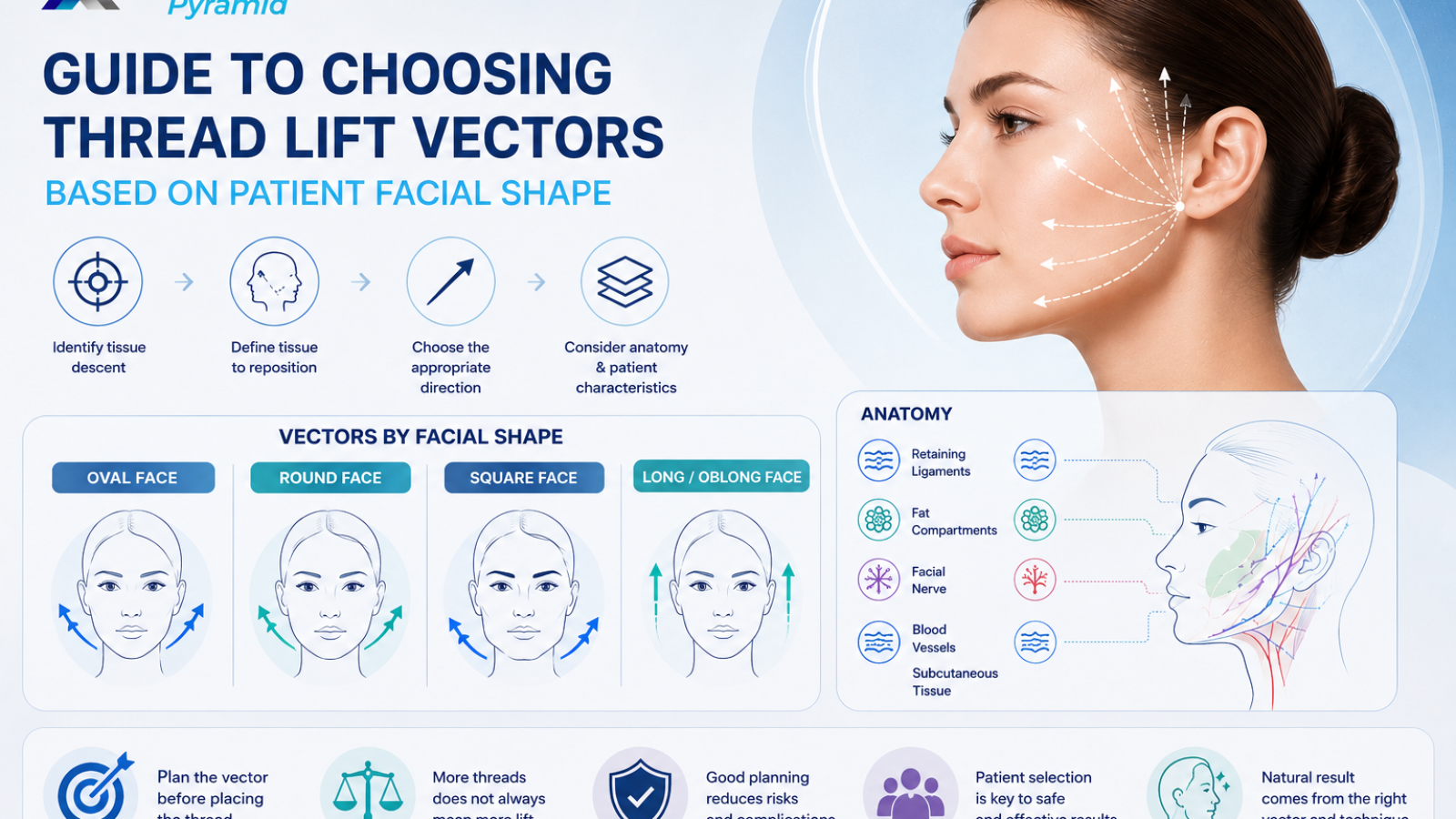
In Thread Lift procedures, selecting the appropriate lifting direction or vector is an important part of treatment planning. Every patient has a different facial shape, tissue distribution, degree of skin laxity, and anatomical characteristics. Therefore, thread lift procedures should not follow the same vector pattern for every patient.
The right vector is not simply about pulling the tissue “upward.” It should be determined based on the desired tissue repositioning and the patient’s individual facial anatomy.
What Is a Vector in Thread Lift?
A vector refers to the planned direction of force used to help reposition tissue during a Thread Lift Technique.
In simple terms, the clinician needs to assess:
Where has the tissue descended, what tissue needs to be repositioned, which direction is most appropriate for that repositioning?
Because the face is a three-dimensional structure, vector planning should take into account the retaining ligaments, fat compartments, tissue quality, as well as vascular and nerve structures.
Therefore, facial shape is one part of the assessment—not the only factor used to determine the lifting vector.
Adapting Thread Lift Vectors to Facial Shape
1. Oval Face
An oval face generally has relatively balanced facial proportions. When signs of skin laxity are present, areas of focus may include the midface, lower cheek, jowls, or jawline.
The vector should be selected according to the location of tissue descent while maintaining the patient’s natural facial proportions.
2. Round Face
For a round face, the cheek and lower face are often important areas to assess. If the soft tissue is relatively heavy, the clinician should consider how the lifting direction may affect the overall facial contour.
A superior-lateral vector may be considered in certain cases, but it should always be adapted to the patient’s tissue characteristics and treatment goals.
3. Square Face
A square face typically has a broader lower face with more defined mandibular structure.
If the treatment goal is to improve jowling or enhance jawline definition, the vector can be planned according to the location of the tissue that needs to be repositioned. An oblique or superior-lateral vector may be considered in selected cases, but it should not automatically be applied to every square-shaped face.
4. Long or Oblong Face
For a relatively long or oblong face, vertical facial proportions should be carefully considered.
A lifting direction that is too dominant in one axis may not produce harmonious contour changes. Assessment of the midface, lower face, and overall facial proportions is therefore important before selecting the vector.
The key principle: facial shape helps guide treatment planning, but anatomy and the patient’s individual aging pattern remain the foundation of clinical decision-making.
Thread Lift Anatomy: The Foundation of Vector Planning
Understanding Thread Lift Anatomy is essential when planning the pathway and direction of thread lift threads.
Several anatomical structures should be considered, including:
- Retaining ligaments, which help maintain the position of facial soft tissue.
- Fat compartments, which can change in volume and position with the aging process.
- Facial nerve, which must be considered when planning the treatment pathway.
- Blood vessels, which are important considerations when determining entry points and thread pathways.
- Skin and subcutaneous tissue, as tissue thickness and quality vary between patients.
A thorough understanding of facial anatomy helps clinicians plan the target, pathway, and vector more precisely.
Does Thread Type Affect Vector Selection?
The choice of thread lift threads should also be matched to the patient’s tissue characteristics and treatment objectives.
Materials such as PDO Threads are commonly used in thread lifting procedures. However, material is only one consideration. Clinicians should also evaluate thread design, cog configuration, tissue engagement, anchoring system, and the patient’s individual tissue characteristics.
With Cog Threads, for example, the cog design provides mechanical engagement with the tissue. However, lifting performance does not depend solely on thread strength.
A useful way to view the treatment strategy is:
Thread Design + Tissue Engagement + Anchoring + Vector + Anatomy = Treatment Strategy
A thread with strong mechanical characteristics still requires appropriate vector and anchoring planning to achieve the intended tissue repositioning.
More Threads Do Not Always Mean More Lift
One important principle in Thread Lift procedures is that the number of threads is not the only factor determining the outcome.
Adding more threads without appropriate planning may increase the risk of issues such as dimpling, asymmetry, contour irregularity, or thread visibility.
A more appropriate approach is:
Plan the vector before placing the thread.
First define the target tissue and desired direction of repositioning, then select the appropriate thread and technique.
Thread Lift Complications and the Importance of Planning
As with any medical procedure, Thread Lift Complications can occur. Reported complications may include swelling, bruising, pain, dimpling, asymmetry, thread visibility or palpability, infection, and thread extrusion.
The risk may vary depending on the patient’s condition, treatment area, thread type, technique, and operator experience.
Therefore, patient selection, anatomical knowledge, thread selection, and vector planning should be considered interconnected components of a comprehensive thread lift procedure.
Conclusion
Choosing a Thread Lift vector should not be based solely on facial shape. Oval, round, square, and long faces may require different strategies, but the final treatment plan should also consider skin laxity, tissue distribution, anatomy, repositioning goals, thread characteristics, and the anchoring system.
Whether using PDO Threads, Cog Threads, or other absorbable thread lift materials, the core principle remains:
Assess the anatomy. Define the target. Plan the vector. Choose the right thread.
With an individualized, anatomy-based approach, clinicians can develop a Thread Lift Technique that is better aligned with each patient’s unique facial structure and treatment objectives.