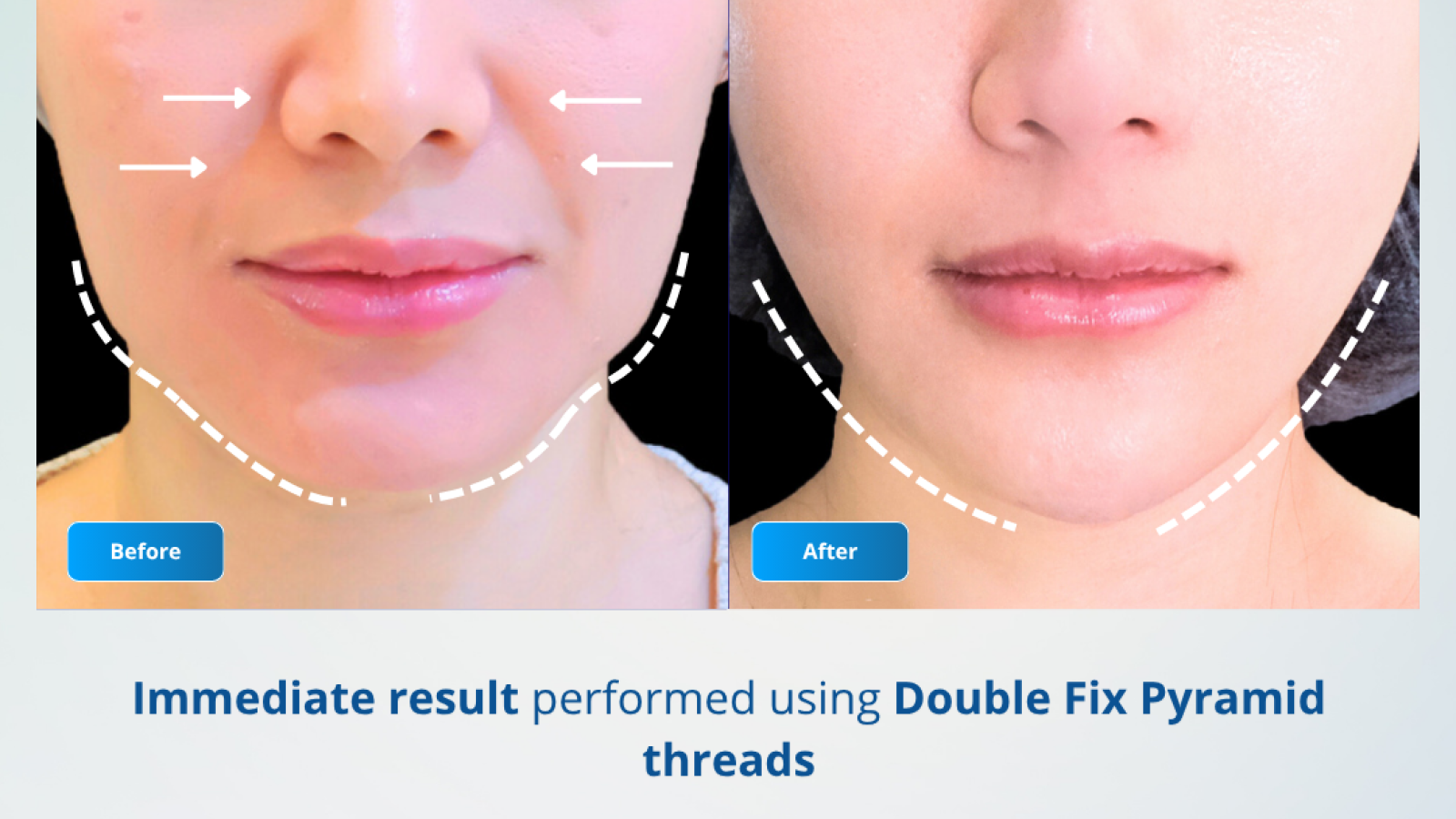
Heavy jowl is one of the most visible changes in lower-face contouring. As the soft tissue of the lower cheek descends, the jowl can appear heavier and the definition of the jawline may become less distinct.
Thread lift for heavy jowl can be a minimally invasive approach to help lift and reposition descended tissue. However, achieving an optimal result is not simply about using stronger or more threads.
For heavy jowl, an effective lifting strategy should consider patient selection, facial anatomy, vector planning, thread design, tissue engagement, and fixation.
The question is not simply:
“How many threads do we need?”
It is:
“Which tissue needs to be repositioned, in which direction, and how can that position be supported?”
What Causes Heavy Jowl?
Heavy jowl is not caused by skin laxity alone. As the face ages, several structural changes can occur simultaneously, including:
- Reduced skin elasticity
- Changes in facial fat compartments
- Soft tissue descent
- Changes in connective tissue and retaining ligaments
- Loss of mandibular border definition
As a result, the lower-face tissue descends and the transition between the lower cheek, jowl, and jawline becomes less defined.
This is why treating heavy jowl requires an understanding of the underlying structures and how the tissue has changed—not simply the appearance of loose skin.
How Does Thread Lift Help Heavy Jowl?
In principle, a thread lift provides mechanical support to help reposition descended or ptotic tissue.
For heavy jowl, the lifting target is not simply to elevate the jowl itself, but to improve the overall transition:
Lower Cheek → Jowl → Jawline
An appropriate vector helps direct the tissue toward the desired position, while tissue engagement and fixation support the repositioned tissue.
This is why thread lift for heavy jowl should be approached as a lifting strategy, rather than simply a pulling procedure.
4 Key Strategies for Thread Lift Heavy Jowl
1. Start with Patient Selection
Not every heavy jowl requires the same approach.
Before selecting a thread, the doctor should assess:
- Degree of skin laxity
- Skin quality and thickness
- Fat distribution
- Degree of tissue descent
- Jowl position and volume
- Jawline definition
- Tissue mobility
- Facial asymmetry
Patients with mild-to-moderate laxity may respond differently from patients with excessive skin redundancy or significant tissue descent.
The right thread cannot compensate for the wrong indication.
2. Define the Vector Based on the Lifting Target
The vector determines the direction of the lifting force.
For heavy jowl, vector planning should be based on the desired treatment outcome, such as:
- Repositioning the lower cheek
- Reducing the appearance of the jowl
- Improving jawline definition
- Creating a more natural lower-face contour
The right vector helps direct the tissue rather than simply pulling the skin.
Therefore, thread selection should follow the lifting strategy—not the other way around.
3. Choose the Thread Based on Tissue Characteristics
Thread selection should take into account:
Thread Design + Tissue Characteristics + Lifting Target + Fixation Strategy
In cog threads, cog configuration plays an important role in how the thread engages with the tissue.
Why Does Pyramid Cog Matter?
Double Fix Pyramid features a Pyramid Cog design developed to support tissue engagement through a cog configuration designed for mechanical interaction with the surrounding tissue.
Thread design matters because lifting performance does not depend on tensile strength alone. It also depends on how the lifting force is transferred from the thread to the tissue.
The thread has to engage the tissue—not just pass through it.
4. Don’t Overlook Fixation
Once the tissue has been repositioned, the next question is:
How is that position supported?
This is why fixation is an important part of the lifting strategy.
Double Fix Pyramid integrates a Dual Fixation System as part of its approach to fixation and mechanical support.
The concept considers the relationship between:
Engagement → Vector → Fixation
A strong thread still requires an appropriate fixation strategy so that the lifting force can be applied in a controlled and purposeful direction.
More Threads ≠ More Lift
Using more threads does not automatically result in better lifting.
If the main issue lies in patient selection, vector, tissue engagement, or fixation, adding more threads will not necessarily solve the problem.
What matters more is determining the appropriate type and amount of support based on the patient’s tissue characteristics and lifting target.
Better lifting is not about using more threads. It is about using the right strategy.
Beyond Tensile Strength: What Matters in Thread Lifting?
Tensile strength is an important parameter when evaluating a thread, but it is not the only factor that influences lifting performance.
Doctors should also consider:
- Tissue engagement
- Anchoring
- Holding strength
- Fixation
- Vector
- Thread design
- Tissue characteristics
Double Fix Pyramid combines an engineering approach through Pyramid Cog, Dual Fixation System, HEATLESS Technology, and tensile strength of up to 5.3 kg.
This approach positions tensile strength as one component of a broader mechanical system—how the thread engages, anchors, and supports tissue according to the planned lifting strategy.
HEATLESS Technology
Thread performance is influenced not only by thread design, but also by how the thread is formed.
HEATLESS Technology is used in the development of Double Fix Pyramid as an approach to forming the thread without using heat to create the cog structure.
By combining thread design and manufacturing technology, Double Fix Pyramid is engineered to support consistent thread characteristics and controlled mechanical interaction with tissue.
When Is Thread Lift Appropriate for Heavy Jowl?
Thread lift for heavy jowl may be considered for patients with mild-to-moderate tissue laxity who are seeking improvement in lower-face contour through a minimally invasive approach.
However, thread lift is not a solution for every degree of facial aging.
Patients with excessive skin redundancy, significant tissue descent, or certain tissue characteristics may require further assessment and a different treatment approach.
Therefore, patient selection remains one of the foundations of successful thread lifting.
Conclusion
Treating heavy jowl with thread lift is not simply about pulling tissue upward.
A more targeted lifting strategy requires:
Patient Selection → Anatomical Assessment → Vector Planning → Thread Selection → Tissue Engagement → Fixation
This is where thread engineering becomes relevant.
With Pyramid Cog, Dual Fixation System, HEATLESS Technology, and tensile strength of up to 5.3 kg, Double Fix Pyramid is engineered not only around thread strength, but also around how the thread interacts with and supports tissue as part of a comprehensive lifting strategy.
However, thread technology must still be supported by appropriate indications, anatomical understanding, and proper clinical technique.
Better lifting is not about pulling harder.
It is about knowing what to lift, where to lift, and how to support it.